We may earn a commission when you book through links on this page, at no extra cost to you. Read our affiliate disclosure.
- Language
- Slovak, West Slavic
- Script
- Latin with diacritics
- Stress
- First syllable
- Related to
- Czech, mutually intelligible
Diesen Reiseführer auf Deutsch lesen
Przeczytaj ten przewodnik po polsku
Přečtěte si tohoto průvodce česky
Olvassa el ezt az útmutatót magyarul
The Slovak phrases to learn first, with pronunciation, are Dobrý deň (good day, DOB-ree dyen), ďakujem (thank you, DYAH-koo-yem) and prosím (please, PRO-seem). They cover most small shop and restaurant situations. Slovak is spelled the way it sounds, and the stress almost always falls on the first syllable, so the pronunciation hints below are easy to use.
English is common in Bratislava and tourist areas, but less so in villages. A greeting in Slovak is noticed and appreciated. Our Slovakia travel tips list other practical basics.
Some links on this page are affiliate links. Taply may earn a commission at no extra cost to you.
Top picks at a glance
Key takeaways
- Stress falls on the first syllable of a word.
- The marks over letters change the sound, so do not ignore them.
- Czech speakers and Slovaks understand each other well.
- A greeting and a thank you go a long way.
Best ways to get by in Slovak, ranked
Ranked by how well each option fits this trip: convenience, cost and who it suits. Some options are affiliate partners. How we rank
-
Our top pick1
Audio tour with WeGoTrip
Best overallBest for: First-time visitors
A WeGoTrip audio tour gives you a guide in English for Old Town streets and sights, so language matters less while you pick up a few words on the way.
See audio tours on WeGoTrip Read our WeGoTrip review- English commentary
- Own pace
- Does not teach Slovak
-
2
Guided tours on Klook
Best for no hassleBest for: Nervous travellers
A guided tour with an English-speaking guide removes the need to order or ask directions. Check the language listed on the tour page.
See tours on Klook Read our Klook review- Guide handles logistics
- Fixed schedule
-
3
eSIM data with Airalo
Best for translation appsBest for: Non-EU visitors
Mobile data lets you use a translation app and maps. Airalo sells data eSIMs, so compare plans before you travel. EU visitors may not need one.
Get an Airalo eSIM Read our Airalo review- Live translation
- Maps
- Not needed with EU roaming
-
4
Learn 20 words yourself
CheapestBest for: Everyone
Twenty words, practiced aloud on the flight, are enough for greetings, ordering and thanks.
- Free
- Warm reactions
- Needs a little practice
How Slovak is pronounced
Slovak uses the Latin alphabet with marks above some letters. A few that matter: č sounds like ch in church, š like sh, ž like the s in measure, ď, ť and ň are soft versions of d, t and n (like dy, ty, ny), and ch is a throaty h as in Scottish loch. An acute accent lengthens a vowel, so á is a longer a. The letter ô sounds like wo.
Every word is stressed on its first syllable, which is why the hints below capitalise the start of each word.
Greetings and politeness
| English | Slovak | Say it like |
|---|---|---|
| Good day (formal) | Dobrý deň | DOB-ree dyen |
| Hi / bye (informal) | Ahoj | AH-hoy |
| Good morning | Dobré ráno | DOB-reh RAH-no |
| Good evening | Dobrý večer | DOB-ree VEH-cher |
| Goodbye | Dovidenia | DO-vee-dyeh-nyah |
| Please / you are welcome | Prosím | PRO-seem |
| Thank you | Ďakujem | DYAH-koo-yem |
| Excuse me / sorry | Prepáčte | PREH-pahch-teh |
| Yes / No | Áno / Nie | AH-no / nyeh |
Use Dobrý deň with shop staff, waiters and older people. Ahoj is for friends and people your age, and you will hear it as both hello and goodbye.
Restaurants and bars
| English | Slovak | Say it like |
|---|---|---|
| Cheers | Na zdravie | NAH-zdrah-vyeh |
| Enjoy your meal | Dobrú chuť | DOB-roo khoot |
| The bill, please | Účet, prosím | OO-chet PRO-seem |
| One beer, please | Jedno pivo, prosím | YED-no PEE-vo PRO-seem |
| I am vegetarian | Som vegetarián | som VEH-geh-tah-ree-ahn |
A woman says Som vegetariánka. For what to order, see Slovak food to try and the Slovak beer guide.
Getting around and getting help
| English | Slovak | Say it like |
|---|---|---|
| How much is it? | Koľko to stojí? | KOL-ko toh STOH-yee |
| Where is...? | Kde je...? | gdeh yeh |
| Toilets | Toalety / WC | TOH-ah-leh-tee / VEH-tseh |
| Do you speak English? | Hovoríte po anglicky? | HO-vo-ree-teh po ANG-lits-ki |
| I do not understand | Nerozumiem | NEH-ro-zoo-myem |
| Help! | Pomoc! | PO-mots |
The emergency number is 112. Useful signs include vchod (entrance), východ (exit), otvorené (open) and zatvorené (closed). For trains see Bratislava to Košice, where station signs are in Slovak.
Slovak phrases for hotels, taxis and shops
These short phrases help at check-in, in a taxi and at a till. Capital letters mark the stressed syllable.
| English | Slovak | Say it like |
|---|---|---|
| I have a reservation | Mám rezerváciu | MAHM REH-zer-vah-tsee-oo |
| To the airport, please | Na letisko, prosím | NAH LEH-tis-ko PRO-seem |
| To the station, please | Na stanicu, prosím | NAH STAH-nyi-tsoo PRO-seem |
| Can I pay by card? | Môžem platiť kartou? | MWO-zhem PLAH-teet KAR-tow |
| Keep the change | Ostatok nechajte | OS-tah-tok NEH-khai-teh |
Start every request with a greeting and end it with prosím or ďakujem. If the other person answers in English, simply carry on in English. For paying and tipping, see money in Slovakia.
Slovak and Czech
Slovak and Czech are closely related and speakers understand each other well. Do not use Czech words to a Slovak waiter as a shortcut, though. Děkuji will be understood but ďakujem is better, and a few words differ in meaning, so keep to Slovak where you can. Hungarian is also spoken in southern Slovakia, which is a different language entirely. Slovene, the language of Slovenia, is another Slavic language but differs from Slovak, see how Slovakia differs from Slovenia. For the Czech side of the story, see Slovakia vs Czech Republic.
Numbers and days
Counting helps with prices and times. One to five are jeden (YEH-den), dva (dvah), tri (tree), štyri (SHTI-ree) and päť (peht). Ten is desať (DEH-saht). Days of the week begin with pondelok (PON-deh-lok) for Monday and end with nedeľa (NEH-deh-lya) for Sunday, which is useful when you read opening hours on shop doors.
Common mistakes with Slovak
Visitors often skip the first-syllable stress, which makes words hard to catch. Another is dropping the soft marks, so ďakujem becomes dakujem, which a Slovak will still understand but which sounds different. Avoid reading ch as in church, because it is a throat sound. Finally, do not worry about grammar: Slovak has six cases, but a short phrase in the basic form is enough for travel. Native speakers are usually patient and pleased that you tried.
Practice aloud on the flight: say each phrase three times with the first syllable stressed. Save the table on your phone for offline use, since mobile data may be limited at a rural bus stop or on a mountain path. A short written note, such as the name of your hotel, also helps when you ask a taxi driver or a passer-by for directions.
Menus, shops and station signs
A few reading words make a menu or a timetable far less confusing. Food and drink: polievka (soup, PO-lyeev-ka), hlavné jedlo (main course), príloha (side dish), dezert (dessert), voda (water), pivo (beer), víno (wine) and káva (coffee). Transport: stanica (station, STAH-nyi-tsa), zastávka (stop), nástupište (platform), lístok (ticket, LEE-stok), odchod (departure) and príchod (arrival).
Shop doors and stations also use ťahať (pull) and tlačiť (push), pokladňa (cash desk or ticket office) and zľava (discount). If a word is not in your head, a translation app with the camera function reads printed signs well. For the practical side of trains, buses and trams, see Bratislava public transport and Bratislava main train station.
A short plan for the first day
- Learn the greeting and thank you first. Say Dobrý deň when you enter a shop, a cafe or a small guesthouse, and dovidenia when you leave.
- Add prosím to every request. It works for ordering, asking for the bill and handing over money.
- Practice Hovoríte po anglicky? so you can ask politely before switching to English.
- Keep the numbers one to ten in mind for prices and platforms.
- Write the name of your hotel and your next destination in your phone notes, spelled with the correct marks.
That short list is enough for most days in Bratislava, Košice and the High Tatras resorts. In small villages and on regional buses, staff are less likely to speak English, so a few more words go a long way. Our guide for solo travellers has more on getting help when you travel alone.
Who needs Slovak and who can skip it
If you stay in Bratislava or a Tatra resort and eat in tourist restaurants, you can manage in English alone. Younger people in cities usually speak it well, and many menus have an English version. Learn more Slovak if you plan to use regional buses, stay in a village guesthouse, shop at local markets or hike where huts are run by small teams. You will also see how much a greeting changes the mood at a counter.
Paying is simple in any case: Slovakia uses the euro, and the notes on money in Slovakia cover cards and cash. Knowing platím kartou (I am paying by card, PLAH-teem KAR-tow) and hotovosť (cash) is handy at small places that prefer one or the other.
Frequently asked questions
Do I need to speak Slovak in Slovakia?
No. English is common in Bratislava, Košice and tourist areas, but less so in small villages.
How do you say thank you in Slovak?
Ďakujem, pronounced roughly DYAH-koo-yem.
How do you say hello in Slovak?
Dobrý deň for a formal hello, and ahoj among friends.
Is Slovak similar to Czech?
Yes. They are closely related and very largely mutually intelligible, though vocabulary and spelling differ.
Is Slovak hard to pronounce?
Spelling follows sound closely, so it is easier than it looks once you learn the marked letters and first-syllable stress.
What is the best word to learn first?
Ďakujem, thank you. It is short, it is used everywhere and staff notice it.
What does vchod mean in Slovak?
Vchod means entrance, and východ means exit. You will see both on doors in shops, stations and public buildings.
How do you say please in Slovak?
Prosím, pronounced PRO-seem. The same word also means you are welcome, and people say it when handing something over, so it is one of the most useful words in Slovak.
How do you say yes and no in Slovak?
Yes is áno (AH-no) and no is nie (nyeh). Both are short and used everywhere, so they are easy to learn alongside dobrý deň, prosím and ďakujem.
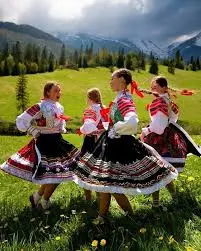
Photo: Slovak language · Davidt164 · CC BY-SA 4.0