We may earn a commission when you book through links on this page, at no extra cost to you. Read our affiliate disclosure.
- Ambulance
- 155
- Any emergency
- 112
- Mountain rescue
- 18 300
- Pharmacy
- lekáreň
In a medical emergency anywhere in Slovakia, call 112 or 155 and give your exact location. EU visitors can use their EHIC for necessary treatment at public providers, while non-EU tourists generally pay in full and should carry travel insurance. Pharmacies are called lekáreň and display a green cross, and English-speaking help is easy to find in Bratislava, Košice and the main resorts.
This guide explains emergency numbers, how EHIC works, where to find a doctor or pharmacy and what travel insurance should cover. Start with insurance: EKTA is our first pick for a quote before you go. See also travel insurance for Slovakia.
Top picks at a glance
Key takeaways
- Ambulance: 155; general emergency: 112.
- EU visitors: bring an EHIC for necessary treatment.
- Non-EU visitors normally pay in full, so insure first.
- Medicines come from pharmacies (lekáreň), marked with a green cross.
- Mountain rescue: 18 300.
How to prepare for a medical issue, ranked
Ranked by how well each option fits this trip: convenience, cost and who it suits. Some options are affiliate partners. How we rank
-
Our top pick1
Travel insurance with EKTA
Best overallBest for: Every visitor, especially non-EU
Travel insurance is the simplest protection against medical bills, repatriation and cancelled trips. EKTA offers online quotes; check that it covers hiking or skiing if you plan them, and keep policy details on your phone.
Get a quote from EKTA Read our EKTA review- Online quote
- Can cover activities
- Check exclusions and limits
-
2
Mobile data with Airalo
Best for finding helpBest for: Finding a pharmacy or hospital
A data eSIM keeps maps, translation and your insurer's app reachable when you need a clinic. Confirm that your phone supports eSIM.
Get an Airalo eSIM Read our Airalo review- Maps and translation
- Phone must support eSIM
-
3
EHIC or GHIC card
Best for EU residentsBest for: EU citizens
EU visitors can use the European Health Insurance Card for necessary treatment at public providers on the same basis as Slovak insured people. It does not replace travel insurance.
Official website- Free to obtain from your national insurer
- Does not cover repatriation or private care
-
4
Private transfer with Kiwitaxi
Best for non-urgent tripsBest for: Non-urgent travel
For a non-emergency trip to a hospital or an airport after treatment, a pre-booked private transfer is an option. Never use it in an emergency, call 155 or 112 instead.
Book a transfer on Kiwitaxi Read our Kiwitaxi review- Door to door
- Not for emergencies
Emergency numbers
Slovakia uses 112 as the EU-wide emergency number, and 155 connects to the emergency medical service. Police are 158 and fire and rescue are 150. In the mountains, the Mountain Rescue Service is reached on 18 300, which is the number to use on trails in the Tatras. Operators in Bratislava and other cities usually handle English, but speak slowly and give your exact location.
| Service | Number |
|---|---|
| Any emergency (EU) | 112 |
| Ambulance | 155 |
| Police | 158 |
| Fire and rescue | 150 |
| Mountain rescue | 18 300 |
EHIC for EU visitors
If you are insured in another EU country, Norway, Iceland, Liechtenstein or Switzerland, bring your European Health Insurance Card. It gives access to necessary treatment during a temporary stay at public healthcare providers under the same conditions as Slovak residents. Small patient charges can apply, and the card does not cover private clinics, repatriation or mountain rescue costs. Without it, you may have to pay and claim a refund later.
UK visitors should check the current rules for the GHIC and carry private cover as well. See travel insurance for non-EU visitors.
Non-EU visitors
Visitors from outside the EU generally pay for medical care in full, so a policy with strong medical and repatriation cover is vital. Keep receipts and medical reports for claims. Policies often exclude activities such as skiing or off-trail hiking, so read the terms and see hiking insurance for the High Tatras and ski insurance in Slovakia.
Pharmacies and everyday problems
A pharmacy is a lekáreň, usually marked with a green cross. Pharmacists can advise on minor problems such as colds, stomach upset, sunburn and insect bites, and some medicines that are over the counter at home may need a prescription in Slovakia. Carry your usual prescription medicines in their original packaging, with a doctor's letter if needed. Larger towns have pharmacies with extended hours, and the notice on a pharmacy door often shows the nearest on-duty one.
For minor illness, ask your hotel for the nearest doctor or clinic, or go to the emergency department in a hospital (nemocnica) if it is serious.
Hospitals and private clinics
Major cities have university hospitals with emergency departments. Private clinics exist in Bratislava, Košice and other cities and are usually paid for by the patient directly, which can mean faster appointments. Ask in advance about prices and keep invoices for your insurer. Dental care is mostly paid out of pocket by tourists.
In the High Tatras, small medical points serve resorts, but serious cases go to hospitals in Poprad or beyond. Read the High Tatras guide and is Slovakia safe for safety context.
Health tips
- Tap water is generally safe to drink.
- Ticks occur in forests and grass from spring to autumn; consider vaccination advice and check your skin after hikes.
- Mountain weather can change fast; carry layers and see the Slovakia packing list.
- Keep your insurer's emergency number saved on your phone.
What to do if you get sick
- For life-threatening problems, call 155 or 112 and state your location.
- For minor illness, ask your accommodation about the nearest doctor or clinic.
- Call your insurer's assistance line before paying large bills, if your policy requires it.
- Keep invoices, receipts and medical reports.
- If you have an EHIC, show it at a public provider and ask for the amount you should pay.
Insurers often have English-speaking assistance lines that can direct you to approved clinics.
Medication and prescriptions
Carry enough regular medication for the whole trip, in its original packaging, with a doctor's note or prescription. Rules for some medicines differ between countries, so check that your medication is legal in Slovakia before you travel. Pharmacies can often suggest an equivalent for a missing medicine, but prescription-only items need a Slovak prescription. Keep medicines in your hand luggage on flights.
Mountain and sports injuries
Hiking and skiing cause the most tourist injuries. Mountain rescue can be reached on 18 300 or through 112, and rescue can be costly if your policy does not cover it. Check your cover before you go; see hiking insurance for the High Tatras and ski insurance in Slovakia. Tell someone your route, and pack a charged phone and a first-aid kit.
Language and communication
Staff at hospitals and clinics in Bratislava, Košice and tourist areas often speak English, but older doctors in smaller towns may not. Write down your symptoms, allergies and medication names in English and, if possible, Slovak. A translation app on your phone, helped by mobile data, is useful. Hotels and guesthouses can often call a doctor for you and explain the situation in Slovak.
Costs and paperwork
Costs vary by provider. Public emergency care for EHIC holders is cheap or free apart from small patient charges, while private clinics and non-EU patients pay full price. Always ask for an itemised invoice and a medical report in English, because insurers need these for claims. Keep your passport details, policy number and emergency contacts together in a note on your phone.
Dental and eye care
Dental emergencies can usually be treated at private clinics in larger cities, and tourists normally pay on the spot. Prices differ widely, so ask for a quote before treatment unless it is urgent. For lost glasses or contact lenses, opticians are common in malls and city centres, and an eye test can be arranged quickly in many places. Keep your prescription details handy.
Frequently asked questions
What number do I call for an ambulance in Slovakia?
Call 155 for the emergency medical service or 112 for the general EU emergency number. In the mountains, call Mountain Rescue on 18 300.
Does the EHIC work in Slovakia?
Yes, it covers necessary treatment at public providers during a temporary stay on the same basis as Slovak insured people. It does not replace travel insurance.
Do tourists need travel insurance in Slovakia?
It is strongly recommended and especially important for non-EU visitors, who generally pay for care in full. It also covers repatriation and activities if selected.
What is a pharmacy called in Slovakia?
A pharmacy is called a lekáreň and is marked by a green cross. Pharmacists can advise on minor ailments.
Do doctors in Slovakia speak English?
Many doctors in cities and tourist areas speak at least some English, but it is less common in small towns. A translation app helps.
Are private clinics available for tourists in Slovakia?
Yes, in larger cities. They are usually paid directly by the patient, so ask about prices first and keep invoices for insurance claims.
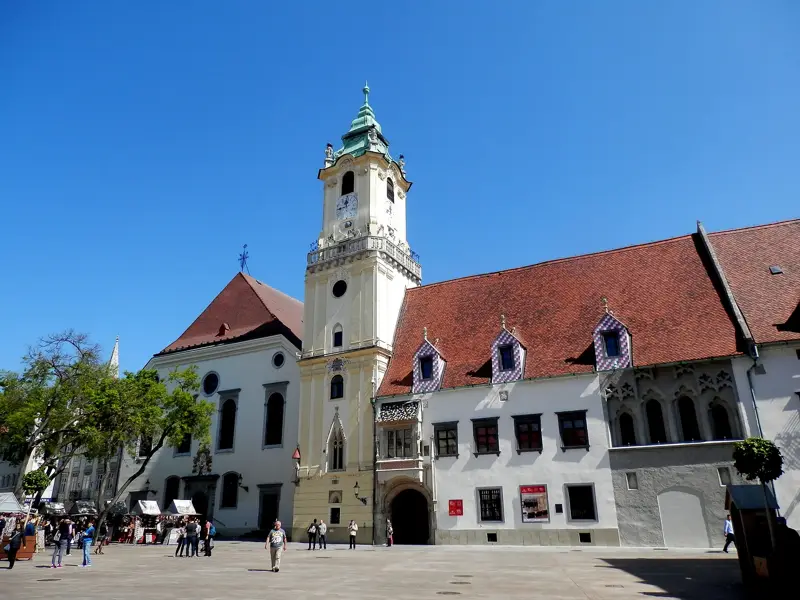
Photo: Old Town Hall (Bratislava) · Jozef Kotulič · CC BY-SA 3.0