We may earn a commission when you book through links on this page, at no extra cost to you. Read our affiliate disclosure.
- Founded
- 28 October 1918
- Velvet Revolution
- November 1989
- Split
- 1 January 1993
- Today
- Czechia and Slovakia
Diesen Reiseführer auf Deutsch lesen
Przeczytaj ten przewodnik po polsku
Přečtěte si tohoto průvodce česky
Olvassa el ezt az útmutatót magyarul
Czechoslovakia was the country that existed from 1918 until 31 December 1992, and it split peacefully into Czechia and Slovakia on 1 January 1993. If you want to see its history on the ground, a guided history walk in Bratislava on Klook or a self-guided audio tour with WeGoTrip is the easiest place to start.
This guide covers what Czechoslovakia was, how it ended, how the two countries differ today and how to travel between them, with links to the places in Bratislava where the story is easiest to follow.
Some links are affiliate links. Taply may earn a commission at no extra cost to you.
Top picks at a glance
Key takeaways
- Czechoslovakia was founded on 28 October 1918 and ended on 31 December 1992.
- The Velvet Revolution ran from 17 November 1989, and the split followed peacefully on 1 January 1993.
- Czechia and Slovakia both joined the EU on 1 May 2004, but only Slovakia uses the euro.
- Czech and Slovak are closely related and largely mutually intelligible.
Best ways to see Czechoslovak history in Bratislava, ranked
Ranked by how well each option fits this trip: convenience, cost and who it suits. Some options are affiliate partners. How we rank
-
Our top pick1
History walking tour on Klook
Best guidedBest for: Visitors who want the story explained
Klook lists guided walking tours in Bratislava. Check which ones cover the 20th century and the Communist era on your dates, and read the meeting point and duration before booking.
See tours on Klook Read our Klook review- Local guide to ask
- Context for sites that have few signs
- Availability varies by date
-
2
Old Town audio tour with WeGoTrip
Best self-guidedBest for: Independent walkers
WeGoTrip sells audio tours for your phone. A self-paced Old Town route lets you add Námestie SNP and the bridge at your own speed.
See audio tours on WeGoTrip Read our WeGoTrip review- Go at your own pace
- No group
- No guide to ask questions
- Check which routes are listed for Bratislava
-
3
Bratislava official visitor site
Official informationBest for: Planning on your own
The city tourism board lists museums, tours and events with current hours.
Official website- Authoritative
- Free
- Covers Bratislava only
-
4
Walk to Slavín and Most SNP
Free optionBest for: Budget travellers
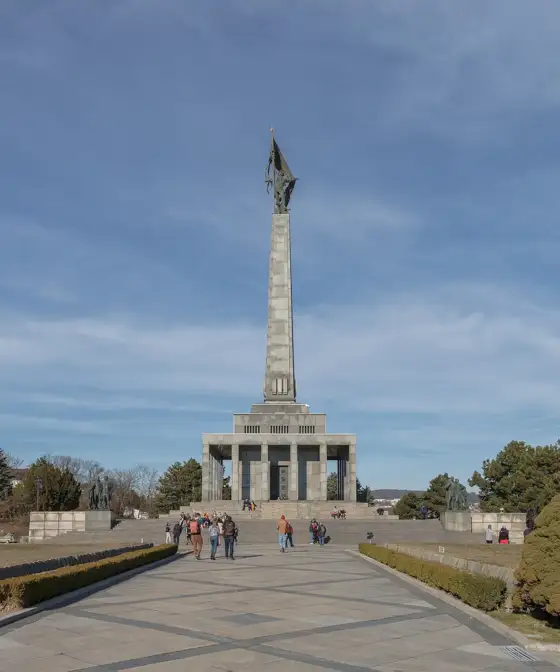
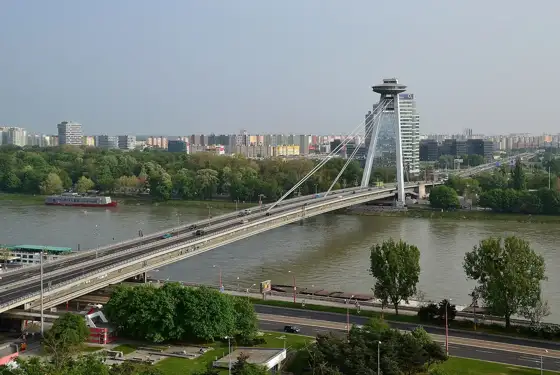
Slavín is a hill walk above the Old Town, and Most SNP and Námestie SNP are close to the centre. You can see all three without a ticket.
- Free
- Flexible
- No explanations on site, so read ahead
What Czechoslovakia was
Czechoslovakia was a country in Central Europe that existed from 1918 until the end of 1992. It joined the Czech lands (Bohemia, Moravia and part of Silesia) with Slovakia in one state, and its capital was Prague. Independence was proclaimed on 28 October 1918, at the end of the First World War.
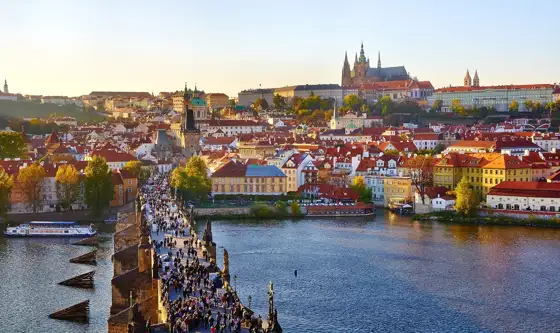
Today the same territory is two countries, Czechia and Slovakia. If you search for Czechoslovakia as a place to visit, the answer is both: Prague and the Czech lands to the west, Bratislava and the mountains of Slovakia to the east. For the Slovak side of the story, see Slovak history for travellers.
From 1918 to the Second World War
The new state brought together people who spoke Czech, Slovak, German, Hungarian and other languages. In September 1938 the Munich Agreement forced Czechoslovakia to give up border regions. In March 1939 the Slovak State was proclaimed on 14 March, and on 16 March Germany declared the Protectorate of Bohemia and Moravia. Slovakia was a separate puppet state allied with Nazi Germany until 1945.
Resistance continued inside Slovakia. The Slovak National Uprising began on 29 August 1944 and is remembered every year. Czechoslovakia was re-established in 1945 as the war ended, and Soviet troops entered Prague on 9 May.
Communist rule and the Prague Spring
The Communist Party took power in February 1948, and Czechoslovakia stayed in the Soviet sphere of influence for more than four decades. In January 1968 Alexander Dubček became First Secretary of the party, and a period of reform known as the Prague Spring began. On the night of 20 to 21 August 1968 Warsaw Pact troops entered the country and the reforms ended.
Dubček was Slovak, which is a reason the Prague Spring matters in Slovakia as well as in Czechia. He also spoke at the Bratislava protests in November 1989.
The Velvet Revolution, 1989
The Velvet Revolution began on 17 November 1989 and was largely peaceful. In Bratislava, students demonstrated on 16 November and a movement called Public Against Violence formed on 19 November. Mass protests followed in the city, moving to the Square of the Slovak National Uprising (Námestie SNP), where Dubček spoke. Demonstrations in Bratislava peaked at around 100,000 people on 25 November, and the Federal Assembly removed the Communist Party's leading role from the constitution on 28 November. Václav Havel was elected president on 29 December 1989.
Námestie SNP is a short walk from the Old Town. Nothing there needs a ticket, so it fits easily into a stroll, see the Old Town walking tour.
The Velvet Divorce, 1993
After the 1992 elections the leaders of the winning parties, Václav Klaus in the Czech lands and Vladimír Mečiar in Slovakia, could not agree on how the federation should work. The Slovak parliament adopted a declaration of independence on 17 July 1992, and the Federal Assembly passed the law ending the state on 25 November 1992. No referendum was held.
Czechoslovakia ceased to exist at the end of 31 December 1992, and the two new countries began on 1 January 1993. The split was peaceful, which is why it is called the Velvet Divorce, echoing the Velvet Revolution. The shared currency lasted a few weeks more, and separate currencies came in on 8 February 1993.
Czechoslovakia, Czechia and Slovakia compared
| Czechoslovakia | Czechia | Slovakia | |
|---|---|---|---|
| Existed | 1918 to 1992 | Since 1 January 1993 | Since 1 January 1993 |
| Capital | Prague | Prague | Bratislava |
| Currency | Czechoslovak koruna | Czech koruna (CZK) | Euro, since 1 January 2009 |
| Population | Not applicable | About 10.9 million (2025 estimate) | About 5.4 million (2026 estimate) |
| EU entry | Never a member | 1 May 2004 | 1 May 2004 |
Both countries joined the Schengen Area on 21 December 2007. Czechia has not adopted the euro. For a fuller country comparison, read Slovakia vs Czech Republic.
Czechoslovak history you can see in Bratislava
Bratislava has a few places that are easy to link to the Czechoslovak period, and all are within reach of the centre.
- Námestie SNP: the square where the 1989 protests gathered, a few minutes from the Old Town.
- Most SNP: the bridge over the Danube, opened on 26 August 1972. Its name refers to the Slovak National Uprising. It was renamed Nový most in 1993 and got the Most SNP name back in 2012. A large part of the Old Town, including almost all of the Jewish quarter, was demolished to make room for the road to it. The flying-saucer shaped restaurant on top is covered in UFO Tower Bratislava.
- Slavín: the Soviet war memorial and cemetery on a hill, built from 1957 to 1960 during the Czechoslovak era, see Slavín Memorial.
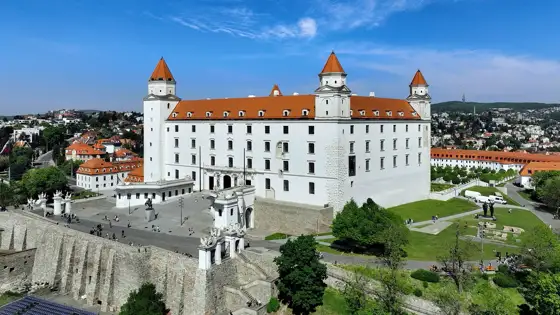
For the wider picture of the city, start with Bratislava and Bratislava museums.
Crossing between Czechia and Slovakia
Both countries are in the Schengen Area, so there are no routine border checks. Carry your passport or ID card anyway. The journey from Prague to Bratislava is about 330 km, and trains, coaches and cars take roughly 4 to 5 hours depending on the mode. Brno is the main city on the way and a good place to break the trip.
Full details of fares and stations are in Prague to Bratislava and Bratislava to Prague. Money changes at the border: Slovakia uses the euro and Czechia the koruna. A city comparison is in Bratislava vs Prague.
Language: Czech and Slovak
Czech and Slovak are separate languages, but they are closely related and have a high degree of mutual intelligibility. Many Czechs and Slovaks understand each other without effort, especially older people who grew up in the shared state. You do not need to speak either to travel, since English is common in tourist areas. A few words go a long way, see Slovak phrases for travellers.
One courtesy tip: do not call either country Czechoslovakia in conversation. People in both are proud of their separate identities, and the name belongs to the past.
Combining Prague and Bratislava
Prague and Bratislava make a natural pair, and many itineraries add Vienna or Budapest. A simple plan is three nights in Prague, two in Bratislava, and a day trip onward. Give each city at least two nights rather than trying to see both in one day. The trip between them takes up most of a day with luggage, so book your seat early on Friday afternoons, Sunday evenings and around public holidays.
If you are building a longer Slovak trip, the 7-day Slovakia itinerary shows how to carry on east after Bratislava.
Frequently asked questions
When was Czechoslovakia founded?
Independence was proclaimed on 28 October 1918, at the end of the First World War.
When did Czechoslovakia split?
Czechoslovakia ceased to exist at the end of 31 December 1992. Czechia and Slovakia became separate countries on 1 January 1993.
What was the Velvet Divorce?
The peaceful split of Czechoslovakia into two countries. The Federal Assembly passed the law on 25 November 1992, and no referendum was held. The name echoes the Velvet Revolution of 1989.
Is Czechoslovakia still a country?
No. It was replaced by Czechia and Slovakia on 1 January 1993.
Do Czechs and Slovaks understand each other?
Largely yes. The two languages are closely related and have a high degree of mutual intelligibility, although they are separate languages.
Can I travel between Czechia and Slovakia without a passport check?
There are no routine border checks because both countries are in the Schengen Area, but you should carry your passport or ID card.
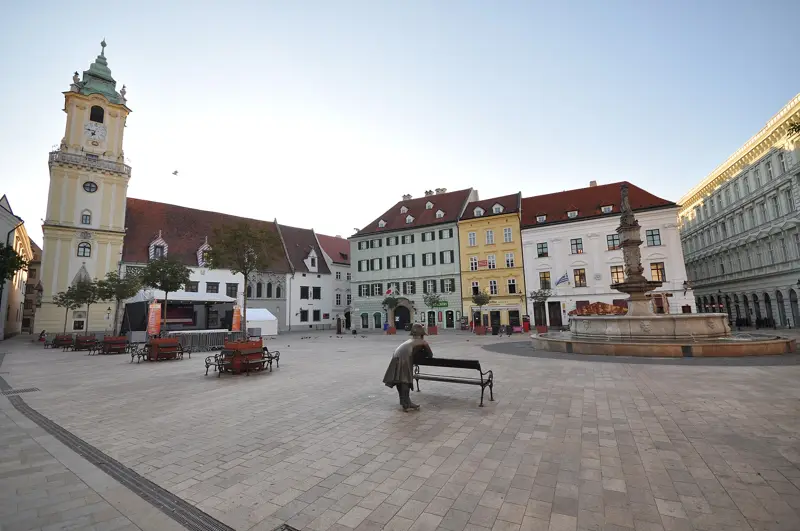
Photo: Main Square (Bratislava) · https://www.flickr.com/photos/jlascar/ · CC BY 2.0